
432 Hz frequency
432 Hz is the note A tuned a little flat: the A above middle C at 432 Hz where the standard is 440. Tap the tile to hear a singing bowl struck at that pitch. It is free, with no ads and nothing to sign up for.
Natural Tuning
Tap the tile to strike the bowl.
The tile strikes a recorded singing bowl, the one the PureSound app uses, tuned to 432 Hz, with the tone itself sounding quietly under it. It rings for about 4 seconds and stops. Keep the volume comfortable.
What is 432 Hz?
It is the note A, tuned 32 cents flat: the A above middle C at 432 Hz where the standard is 440, a difference of about a third of a semitone. Music “in 432 Hz” is ordinary music with every note lowered by that much.
432 Hz is often listed among the healing frequencies, beside the solfeggio tones, but it is a different thing. Those are fixed pitches. 432 Hz is a tuning: a choice of where the A sits, which moves every other note with it.
432 Hz vs 440 Hz
The two put the A above middle C 8 Hz apart. That is 32 cents, where a cent is a hundredth of a semitone, so a piano tuned to 432 Hz sounds about a third of a semitone lower on every key and is otherwise the same instrument.
A standard pitch is an agreement, and a recent one. In Italy before the 1880s, where the A sat varied by region, and 440 Hz only became the standard at an international conference in 1939.
432 Hz is sometimes called Verdi tuning. The composer backed a standard of 435 and on another occasion suggested that 432 was more comfortable. The name came a century later: the Schiller Institute began to promote “Verdi tuning” in the late 1980s.
432 Hz frequency benefits: what the studies found
432 Hz is said to be more natural and more relaxing than standard pitch. A handful of small trials have tested that by playing people the same music at both tunings, and the results so far have been mixed and are not yet conclusive. Two of the trials measured heart rate. In a 2019 pilot with 33 volunteers, it fell by about five beats a minute more after 20 minutes of film music tuned to 432 Hz than after the same music at 440, and the authors asked for a larger trial. In a 2025 trial with 43 patients, it fell by 3 beats a minute after 15 minutes of an instrument tuned to 432 Hz and by 1 after the same at 443, the pitch German orchestras tune to. Most of that trial’s other heart and circulation measures did not differ between the two tunings, and mood improved after both.
One measured anxiety. In a 2020 trial with 42 dental patients, scores after 15 minutes of music were alike at either tuning and about half those of patients who heard none, while the stress hormone cortisol was lower with 432.
And one went the other way. In a 2025 study, 22 athletes performed slightly better after warming up to music at the standard tuning than at 432.
Each of these played music, or an instrument, tuned to 432 Hz. None of them tested the pitch sounded by itself, which is what the tile at the top of this page plays. If you find it calming, that is reason enough to listen.
Questions people ask
What does 432 Hz do?
Nothing has been reliably shown yet. In small trials heart rate fell a little further after music at 432 Hz than at standard pitch, anxiety fell the same at both, and athletes did slightly better at 440. Each is described above.
On the brain, one small study recorded 15 men during a daytime nap, with 432 Hz music and without. Their brain waves showed more alpha activity as they fell asleep with it, which its authors read as a calming effect.
What note is 432 Hz?
The A above middle C, tuned 32 cents flat. On a piano at standard pitch that A is 440 Hz and the G♯ below it is 415.3 Hz, so 432 Hz falls between the two keys, about a third of the way down from the A.
Is 432 Hz a solfeggio frequency?
No. The solfeggio frequencies are nine fixed pitches, from 174 Hz to 963 Hz, and 432 is not one of them. It is a tuning for the note A. The two are often listed together, and the seven best-known solfeggio tones can be heard on the page about healing frequencies.
Is 432 Hz good for sleep?
Possibly, but the evidence is thin and nothing is conclusive yet. A search of the medical literature in November 2026 returned two studies of 432 Hz and sleep, both small.
In the first, 12 patients with spinal injuries listened to their own music for 30 minutes a day. Their sleep scores improved after the stretch at 432 Hz and did not after the stretch at 440. It was a pilot, and its authors asked for larger samples.
In the second, 15 men who were slow to fall asleep napped with 432 Hz music and without. They fell asleep no sooner with it, though their brain waves showed more of the alpha activity its authors read as calm.
Is 432 Hz dangerous?
No. 432 Hz is an ordinary audible pitch: the A above middle C, a little flat.
Advice on safe listening does not single out any pitch. What it limits is loudness over time: the World Health Organization gives 80 dB for up to 40 hours a week as safe, and 90 dB for only four.
How long should you listen to 432 Hz?
There is no researched answer. The trials described above played it for 15 or 20 minutes at a sitting, one study of sleep used 30 minutes a day, and none compared one length with another. Listen for as long as you enjoy it, at a comfortable volume.
432 Hz, in the app
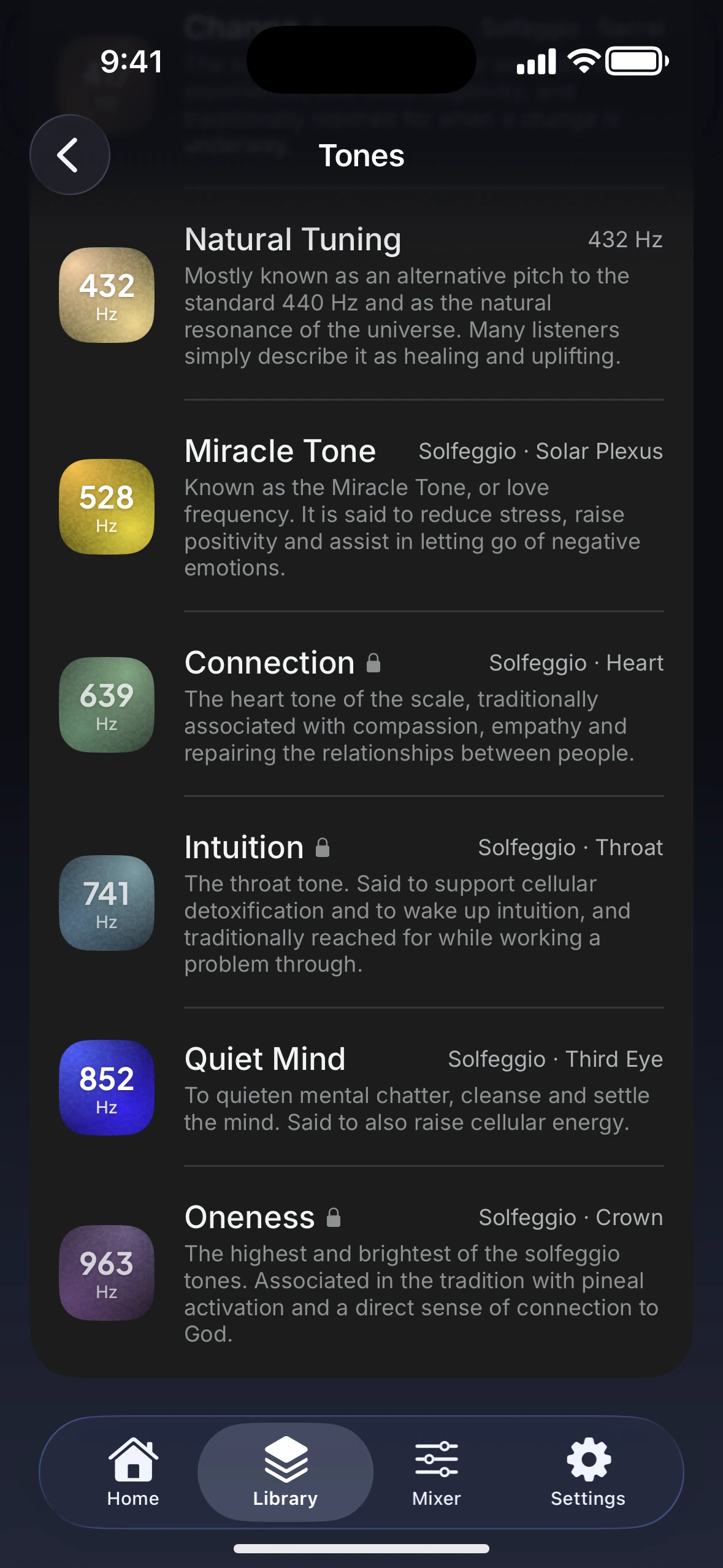
432 Hz is one of the free tones in the PureSound app for iPhone and iPad. There it rings over the same singing bowl and holds for the whole session. The app adds a timer, sessions at any length up to 12 hours with play and pause on the lock screen, and a Mixer that layers up to 3 sounds at once.
Free to start. No account needed.