
The 7 healing frequencies
What people call the 7 healing frequencies are seven solfeggio tones, one for each chakra, from 396 Hz at the root to 963 Hz at the crown. Tap a tile to hear a singing bowl struck at that pitch. It is free, with no ads and nothing to sign up for.
- Letting GoRoot
- ChangeSacral
- Miracle ToneSolar plexus
- ConnectionHeart
- IntuitionThroat
- Quiet MindThird eye
- OnenessCrown
Each tile strikes a recorded singing bowl, the one the PureSound app uses, tuned to that tone, with the tone itself sounding quietly under it. It rings for about 4 seconds and stops. Keep the volume comfortable.
What are solfeggio frequencies?
Nine pitches, from 174 Hz to 963 Hz, each said to do something for the body or the mind. Six of them (396, 417, 528, 639, 741 and 852 Hz) were first published in 1999, in a book by Leonard Horowitz, and are said to have been drawn by Joseph Puleo from a pattern in the verse numbers of the Bible’s Book of Numbers (Chapter 7:12-83), which lists the offerings that twelve leaders of Israel brought for the dedication of the altar, one leader a day. Horowitz added 174, 285 and 963 Hz later, as he tells it in The Book of 528 (2011).
The seven on this page are the ones now paired with the seven chakras, from 396 Hz at the root to 963 Hz at the crown. The two lowest of the nine, 174 and 285 Hz, are not among them.
The name appears to come from solfège, the do-re-mi syllables singers learn. Those go back to a medieval hymn, Ut queant laxis, which Guido of Arezzo used to teach how one note relates to the next. The scientific community remains sceptical of the claims made for these tones.
Do healing frequencies work?
There is not enough research to form a conclusion just yet. What research there is mostly tests music retuned to contain 432 Hz or 528 Hz, not one pitch sounded by itself as it is here, and most of the studies are small. A study often cited for 528 Hz had nine people listen to five minutes of music. Their level of cortisol, a stress hormone, fell after music tuned to include 528 Hz and did not fall significantly after music at standard pitch. A 2026 trial with 162 students compared 528 Hz music, 432 Hz music and no music: some saliva markers were higher after the 528 Hz music than after none, scores on an attention test did not differ, and no group heard music at standard pitch.
Music tuned to 432 Hz has been compared with standard tuning more often, with mixed results. What was found is on the page about 432 Hz.
Fact-checkers who went through some of the claims found no evidence that these frequencies have an effect on the body.
None of the other six tones on this page has had a trial of its own. The nearest is a 2026 sleep study in which 20 students heard a binaural beat carried on a 174 Hz tone, which tested the beat and not the pitch.
The seven tones, one by one
What follows is what each tone is said to do, in the words the PureSound app uses for it. These are beliefs that travel with the tones, not findings. The research described above covers music tuned to 432 Hz and 528 Hz only.
396 HzLetting Go, root chakra
The root of the solfeggio scale, traditionally associated with releasing fear, guilt and the blockages people don't know they're carrying.
Nearest note: 18 cents above G4
417 HzChange, sacral chakra
The sacral tone. Said to clear away difficult experiences and undo negativity, and traditionally reached for when a change is underway.
Nearest note: 7 cents above G♯4
528 HzMiracle Tone, solar plexus chakra
Known as the Miracle Tone, or love frequency. It is said to reduce stress, raise positivity and assist in letting go of negative emotions.
Nearest note: 16 cents above C5
639 HzConnection, heart chakra
The heart tone of the scale, traditionally associated with compassion, empathy and repairing the relationships between people.
Nearest note: 46 cents above D♯5
741 HzIntuition, throat chakra
The throat tone. Said to support cellular detoxification and to wake up intuition, and traditionally reached for while working a problem through.
Nearest note: F♯5
852 HzQuiet Mind, third eye chakra
To quieten mental chatter, cleanse and settle the mind. Said to also raise cellular energy.
Nearest note: 44 cents above G♯5
963 HzOneness, crown chakra
The highest and brightest of the solfeggio tones. Associated in the tradition with pineal activation and a direct sense of connection to God.
Nearest note: 44 cents below B5
Notes are those of a piano tuned the standard way, with the A above middle C at 440 Hz. A cent is a hundredth of a semitone. Of the seven, only 741 Hz lands on a key (F♯5).
Questions people ask
What are the 7 healing frequencies?
Usually 396, 417, 528, 639, 741, 852 and 963 Hz. Each is paired with one of the seven chakras, from the root at 396 Hz to the crown at 963 Hz, and they are the seven tiles at the top of this page.
The seven are a convention more than a rule. Lists differ from one source to the next, and the full solfeggio scale has nine tones.
What are the 9 solfeggio frequencies?
They are 174, 285, 396, 417, 528, 639, 741, 852 and 963 Hz. The middle six were published first, in 1999. The two lowest and the highest were added later by Leonard Horowitz, whose book it was. The seven on this page are the ones from 396 Hz up.
What is the healing frequency?
There is no single one. The name most often goes to 528 Hz, also called the miracle tone or the love frequency, and some sources give it to 963 Hz.
What is 528 Hz good for?
528 Hz is known as the miracle tone or the love frequency, and is said to lower stress. In one small study, nine people had lower levels of the stress hormone cortisol after five minutes of music tuned to include 528 Hz.
What note is 528 Hz?
No note of a standard piano exactly. It sits 16 cents above C5, the C an octave above middle C, where a cent is a hundredth of a semitone. Tune the A above middle C to 444 Hz in place of 440 and that C lands on 528 Hz, which is how music “in 528 Hz” is made.
Is 528 Hz dangerous?
No. 528 Hz is an ordinary audible pitch, a little above the C an octave over middle C.
Advice on safe listening does not single out any pitch. What it limits is loudness over time: the World Health Organization gives 80 dB for up to 40 hours a week as safe, and 90 dB for only four.
Are 852 Hz and 963 Hz dangerous?
No. 852 Hz sits 44 cents above G♯5 and 963 Hz 44 cents below B5: ordinary high notes. The only risk is the one any sound carries, which is volume, so keep it low and comfortable.
Why is 963 Hz called the God frequency?
Probably because of where it sits. It is the highest of the nine tones and is paired with the crown chakra, which the tradition links with oneness and the divine. That may be why videos and playlists took to calling it the God frequency.
How long should you listen to a solfeggio frequency?
There is no researched answer, for 417 Hz or any other. The trials described above ran from 5 minutes to 20 in a sitting, and none of them compared one length with another. Listen for as long as you enjoy it, at a comfortable volume.
What about 432 Hz?
432 Hz is a different thing: not a solfeggio tone but a tuning, with the A above middle C at 432 Hz in place of the standard 440. It is not one of the seven, and it has a page of its own, where it can be heard.
The same tones, in the app
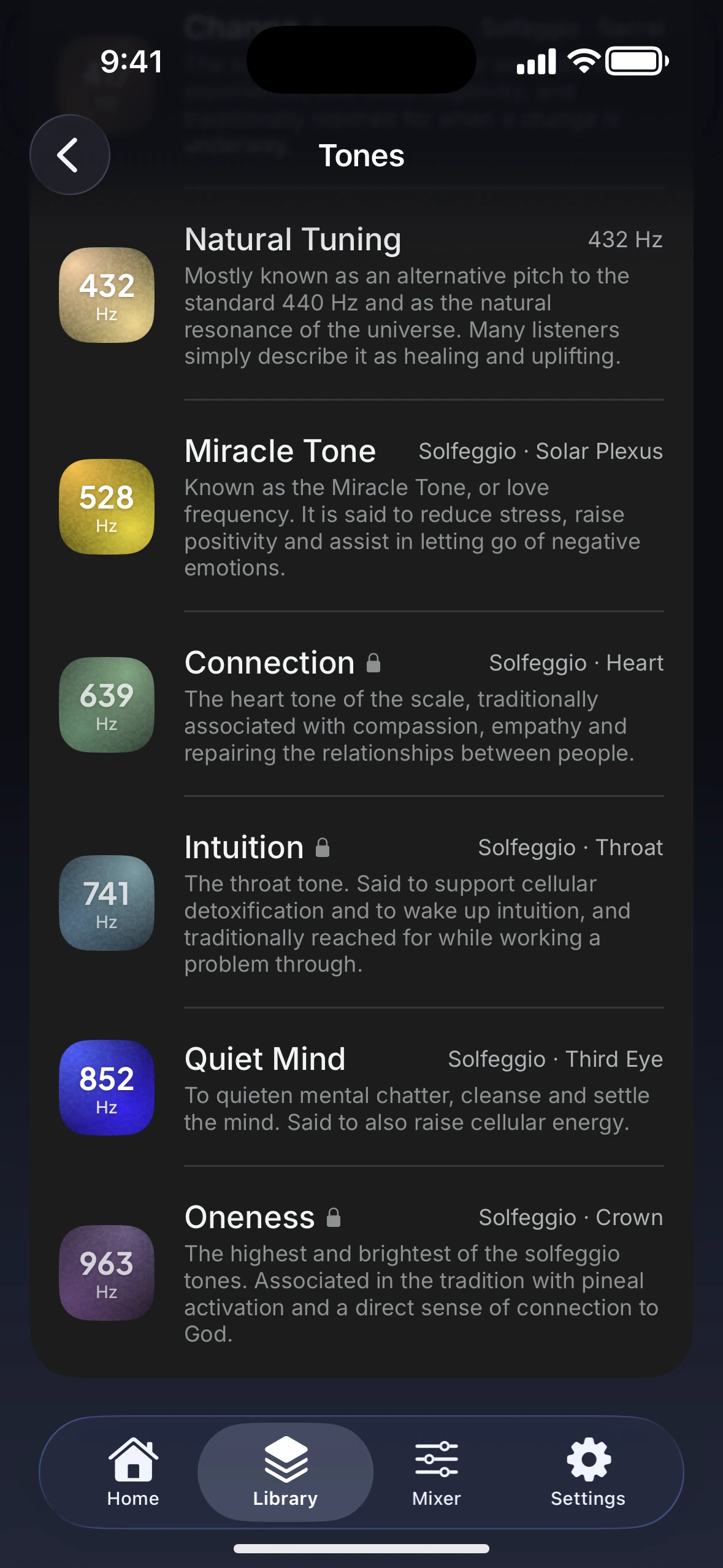
In the PureSound app for iPhone and iPad each tone rings over the same singing bowl and holds for the whole session. Of these seven, 528 Hz and 852 Hz are free there, and the other 5 come with the paid Pro subscription. The app has 3 more tones: 174 Hz and 285 Hz with Pro, and 432 Hz, which is free. The app adds a timer, sessions at any length up to 12 hours with play and pause on the lock screen, and a Mixer that layers up to 3 sounds at once.
Free to start. No account needed.