
Brown noise
A deep, steady rumble, like a waterfall heard from inside. Press play. It is free, with no ads and nothing to sign up for.
Press play to start.
On a recent iPhone it keeps playing with the screen locked and the silent switch on. Keep the volume comfortable, especially for long listening.
What is brown noise?
Brown noise is a steady, random sound weighted toward the bass. Its power at each frequency falls by about 6 dB with each octave you go up, so most of it sits in the low frequencies and very little is left at the top. It sounds like a waterfall heard from inside, or the cabin of a plane at cruising height.
The name has nothing to do with the colour. It comes from Robert Brown, the botanist Brownian motion is named after: add up a long run of random steps, as that motion does, and this is the sound you get. It is also called Brownian noise or red noise.
Power per hertz, against white noise
Frequency
What people use it for
As a background: to cover traffic or voices, to stay with a piece of work, or to fall asleep to. If white noise sounds too sharp to you, brown has far less treble. Which colour suits you is a matter of taste, so try the others below.
How this one is made
No audio is downloaded or streamed. Your browser generates random samples and passes them through a simple filter that is level below about 150 Hz and falls 6 dB an octave above it, which keeps the deepest rumble in check. It is the brown noise from the PureSound app, made from the same recipe: a 20-second loop with its ends blended so there is no seam, and left and right generated separately so the sound sits wide instead of in the middle of your head.
Questions people ask
What is brown noise good for?
The same job as the other colours: covering background sound with something steady, for sleeping, working or studying. It has far less treble than white or pink noise, so it is the one to try if a hiss tires you.
Its reputation for focus comes from listeners more than from trials. A 2024 analysis of noise and attention in people with ADHD found no studies of brown noise. Two small experiments have tried it on other people. In one, 22 people scored better on three of four tests with red noise, another name for brown, than in quiet, and pink and white noise helped too. In the other, which compared brown noise, slow music, fast music and silence in 26 adults, only the slow music improved attention.
Is brown noise good for sleep?
It has hardly been tested. A search of the medical literature in November 2026 found one study that played it: in a hospital unit, patients who used an app that played white noise one day, pink the next and brown on the third scored better for sleep than patients without it on each of the three days, with 54 patients in all. The colours were not compared, so there is no evidence that brown works better or worse than white or pink.
The rest of what is known is about steady noise in general. It can make the sounds that wake you stand out less, and a 2021 review of 38 studies rated the evidence that it improves sleep as very low quality. If you like the sound, play it quietly and judge by how you sleep.
Does brown noise help with ADHD?
It had not been tested when the research was last pulled together, in 2024. That analysis of 13 studies found that white noise, and pink in the one study that used it, gave children and young adults who have ADHD, or score high for it, a small lift on attention tasks. It could find no studies of brown noise at all, and its authors note how fast public interest in these sounds has grown.
Is brown noise harmful?
Not at a moderate volume. Nothing about brown noise makes it riskier than any other sound: what matters for hearing is how loud it is and for how long. Sounds at or below 70 dBA are unlikely to cause hearing loss even after long exposure, according to the US National Institute on Deafness and Other Communication Disorders.
What frequency is brown noise?
It is not one frequency. Brown noise contains every frequency you can hear, with the power falling by about 6 dB for each octave you go up, so the low end dominates. The brown noise on this page is level below about 150 Hz and falls away above it.
Does brown noise make you poop?
No. That idea belongs to the “brown note”, a supposed tone too low to hear that makes people lose control of their bowels. Brown noise is something else: ordinary audible noise, named after the botanist Robert Brown.
The brown note has not been shown to exist. A 2001 review of research on acoustic weapons found no hard evidence that very low sound causes loss of bowel control, even at 170 dB.
The four colours
| Colour | How its power is spread | Sounds like |
|---|---|---|
| White noise | The same power at every frequency | A fan, or a TV between channels |
| Pink noise | Falls 3 dB with each octave | Steady rain, or wind through trees |
| Brown noise (this page) | Falls 6 dB with each octave | A waterfall heard from inside, or a plane at cruising height |
| Green noise | No agreed definition. Ours is gathered in the middle, around 500 Hz | Wind in leaves, or a river at a distance |
The same sound, in the app
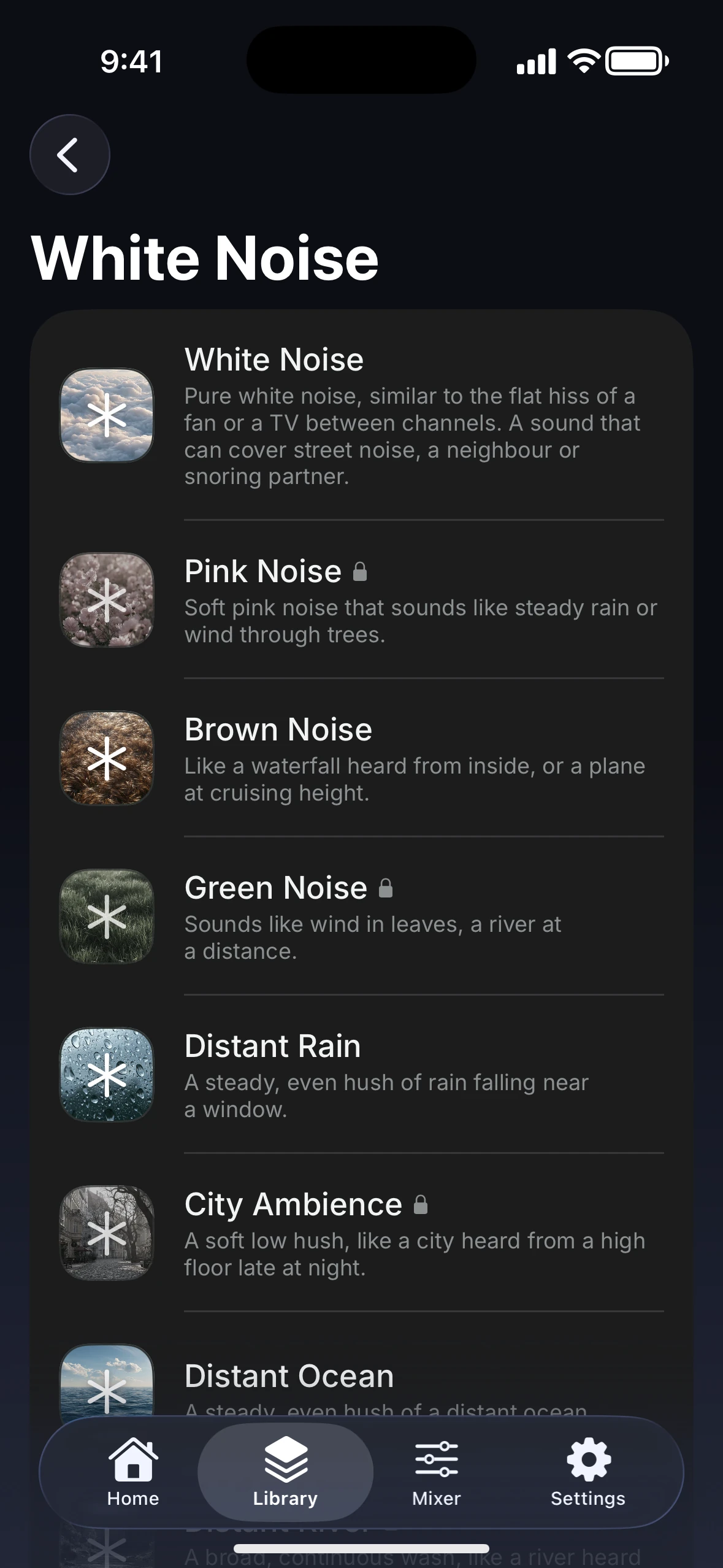
Brown noise is free in the PureSound app for iPhone and iPad. The app adds a timer, sessions at any length up to 12 hours with play and pause on the lock screen, and a Mixer that layers up to 3 sounds at once.
Free to start. No account needed.