
Green noise
A soft wash of mid-range sound, like wind in leaves or a river at a distance. Press play. It is free, with no ads and nothing to sign up for.
Press play to start.
On a recent iPhone it keeps playing with the screen locked and the silent switch on. Keep the volume comfortable, especially for long listening.
What is green noise?
Green noise has no agreed technical definition. The name is commonly used for noise that emphasises the middle of the range, around 500 Hz.
Ours is pink noise with the deep bass and the top hiss filtered away and a gentle lift around 500 Hz, so it has less rumble than brown noise and less hiss than white. It sounds like wind in leaves, or a river at a distance.
Power per hertz, against white noise
Frequency
What people use it for
People play it to sleep to, and as a calm background for reading or working, much as they use the other colours. It is the only one of the four with both ends filtered away: more than nine tenths of its power sits between 120 Hz and 3 kHz.
How this one is made
No audio is downloaded or streamed. Your browser generates pink noise, then filters it: a highpass at 120 Hz, a lowpass at 3 kHz, and a 4 dB lift around 500 Hz. It is the green noise from the PureSound app, made from the same recipe: a 20-second loop with its ends blended so there is no seam, and left and right generated separately so the sound sits wide instead of in the middle of your head.
Questions people ask
What is green noise good for?
People use it as a calm background for sleep, reading or work, as they use the other colours.
There is no research on it. A search of the medical literature for green noise in November 2026 returned a dozen papers, none about sleep or health: in printing, imaging and physics the term means something else. So nothing is known about green noise beyond what any quiet, steady sound does, which is to cover other noise.
Is green noise good for sleep?
It has not been tested, so nobody can say it is better or worse than any other colour: a search of the medical literature in November 2026 found no sleep study of it. The reason to pick it is that you like it. It has less rumble than brown noise and less hiss than white.
Is green noise bad for you?
No more than any other sound at the same volume. It is ordinary noise with the deep bass and the top hiss filtered away, so there is nothing in it that the other colours lack. Keep it moderate. Sounds at or below 70 dBA are unlikely to cause hearing loss even after long exposure, according to the US National Institute on Deafness and Other Communication Disorders.
What is the difference between green noise and white noise?
White noise is flat: the same power at every frequency, from the lowest rumble to the highest hiss. Green noise, as this page makes it, keeps the middle and drops both ends, with more than nine tenths of its power between 120 Hz and 3 kHz. White sounds like a hiss, and green more like wind in leaves.
What frequency is green noise?
There is no standard. The name is commonly used for noise that emphasises the middle of the range, around 500 Hz. The green noise on this page keeps 120 Hz to 3 kHz, with a 4 dB lift around 500 Hz.
The four colours
| Colour | How its power is spread | Sounds like |
|---|---|---|
| White noise | The same power at every frequency | A fan, or a TV between channels |
| Pink noise | Falls 3 dB with each octave | Steady rain, or wind through trees |
| Brown noise | Falls 6 dB with each octave | A waterfall heard from inside, or a plane at cruising height |
| Green noise (this page) | No agreed definition. Ours is gathered in the middle, around 500 Hz | Wind in leaves, or a river at a distance |
The same sound, in the app
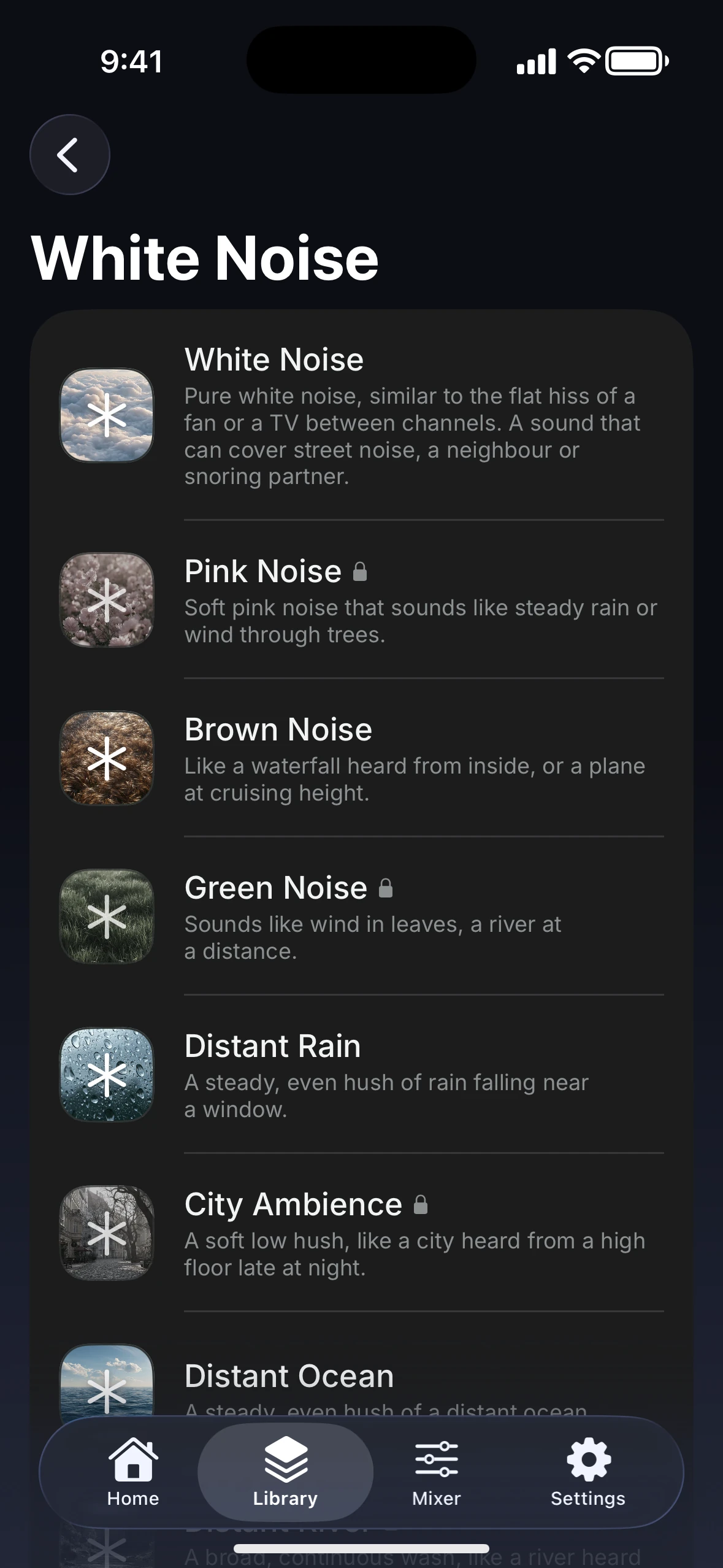
In the PureSound app for iPhone and iPad, green noise comes with the paid Pro subscription, and white and brown noise are free. The app adds a timer, sessions at any length up to 12 hours with play and pause on the lock screen, and a Mixer that layers up to 3 sounds at once.
Free to start. No account needed.