
White noise
A flat, bright hiss, like a fan or a TV between channels. Press play. It is free, with no ads and nothing to sign up for.
Press play to start.
On a recent iPhone it keeps playing with the screen locked and the silent switch on. Keep the volume comfortable, especially for long listening.
What is white noise?
White noise is a steady, random sound with the same power at every frequency across its range. It is named after white light, which is every visible colour at once.
Each octave up the scale spans twice as many hertz as the one below it, so in white noise each carries twice the power. That is part of why it sounds bright: a hiss, with far more treble than bass.
Power per hertz, against white noise
Frequency
What people use it for
To cover sounds that come and go, like traffic, voices through a wall or a partner who snores, and as a steady background for sleeping, studying or working. If it is too sharp for you, pink and brown noise are the same idea with less treble.
How this one is made
No audio is downloaded or streamed. Your browser generates random samples and plays them as they are, with no filter, which is all white noise is. It is the white noise from the PureSound app, made from the same recipe: a 20-second loop with its ends blended so there is no seam, and left and right generated separately so the sound sits wide instead of in the middle of your head.
Questions people ask
What does white noise do?
It covers other sounds. A steady hiss raises the background level, so a door, a voice or a passing car stands out less against it. In a sleep-laboratory study of four people, adding white noise to recorded hospital noise brought the number of times sleepers were roused back down to about what it was on a quiet night.
Does white noise help you sleep?
It can, mainly where the problem is other noise. A 2021 review of 38 studies found results varied from better sleep to worse sleep.
A 2025 analysis of 12 randomised trials was more positive: adults reported better sleep quality with white noise. All of those adults were patients, more than half of them in intensive or coronary care, and the trials differed a good deal from one another.
Is white noise bad for you?
Not at a moderate volume, as far as hearing goes. Sounds at or below 70 dBA are unlikely to cause hearing loss even after long exposure, according to the US National Institute on Deafness and Other Communication Disorders. Louder than that, time counts too: the World Health Organization gives 80 dB for up to 40 hours a week as safe, and 90 dB for only four.
Is white noise bad for babies?
It can be, if it is too loud or too close. A 2014 study played 14 infant sleep machines at full volume. Every one was louder at 30 cm than the 50 dBA limit recommended for hospital nurseries, and three were louder than 85 dBA, which over eight hours is more than workplace limits allow for adults.
The American Academy of Pediatrics tells parents that some machines can produce hazardous noise levels, and that a sleep machine should go as far from the baby’s head as possible and be used for a short time only.
Loudness may not be the only question. In a 2026 laboratory study, steady pink noise cut adults’ REM sleep, and its authors caution against using such sounds indiscriminately, above all for newborns and toddlers, for whom that kind of sleep matters most.
A phone or a laptop playing this page deserves the same care.
How loud should white noise be for a baby?
As quiet as still works, and well away from where the baby sleeps. The American Academy of Pediatrics’ advice to parents gives no decibel figure: it says to place a sleep machine as far from the baby’s head as possible and to use it for a short time only.
A figure you may see quoted, 50 dBA, is the limit recommended for hospital nurseries. The 2014 study of infant sleep machines used it as a yardstick and found that every machine it tested could exceed it at 30 cm at full volume. Turning it down and moving it away both help.
What is the difference between white noise and brown noise?
White noise has the same power at every frequency, so it sounds bright: a hiss. Brown noise loses about 6 dB with each octave you go up, so most of its power sits in the bass: a rumble. Both are used to cover background sound, and which is easier to listen to is a matter of taste.
How do you play white noise on an iPhone?
Press play at the top of this page. It runs in Safari with nothing to install, and on a recent iPhone it keeps playing with the screen locked.
There is also the PureSound app for iPhone and iPad, where white noise is free and no account is needed. The app adds a timer, sessions at any length up to 12 hours with play and pause on the lock screen, and a Mixer that layers up to 3 sounds at once. So white noise can play under rain or a fireplace, both free there, as brown noise is.
iPhones also have a built-in option called Background Sounds, which needs iOS 15 or later. Apple’s guide gives the steps: open Settings, tap Accessibility, then Audio & Visual, then Background Sounds, and turn it on.
Is rain white noise?
Not in the technical sense. White noise has equal power at every frequency, and the sound of rain depends on what the drops land on. People call rain white noise because it does the same job: it covers other sounds with a steady one. There is more on this, and rain to play, on the rain sounds page.
The four colours
| Colour | How its power is spread | Sounds like |
|---|---|---|
| White noise (this page) | The same power at every frequency | A fan, or a TV between channels |
| Pink noise | Falls 3 dB with each octave | Steady rain, or wind through trees |
| Brown noise | Falls 6 dB with each octave | A waterfall heard from inside, or a plane at cruising height |
| Green noise | No agreed definition. Ours is gathered in the middle, around 500 Hz | Wind in leaves, or a river at a distance |
The same sound, in the app
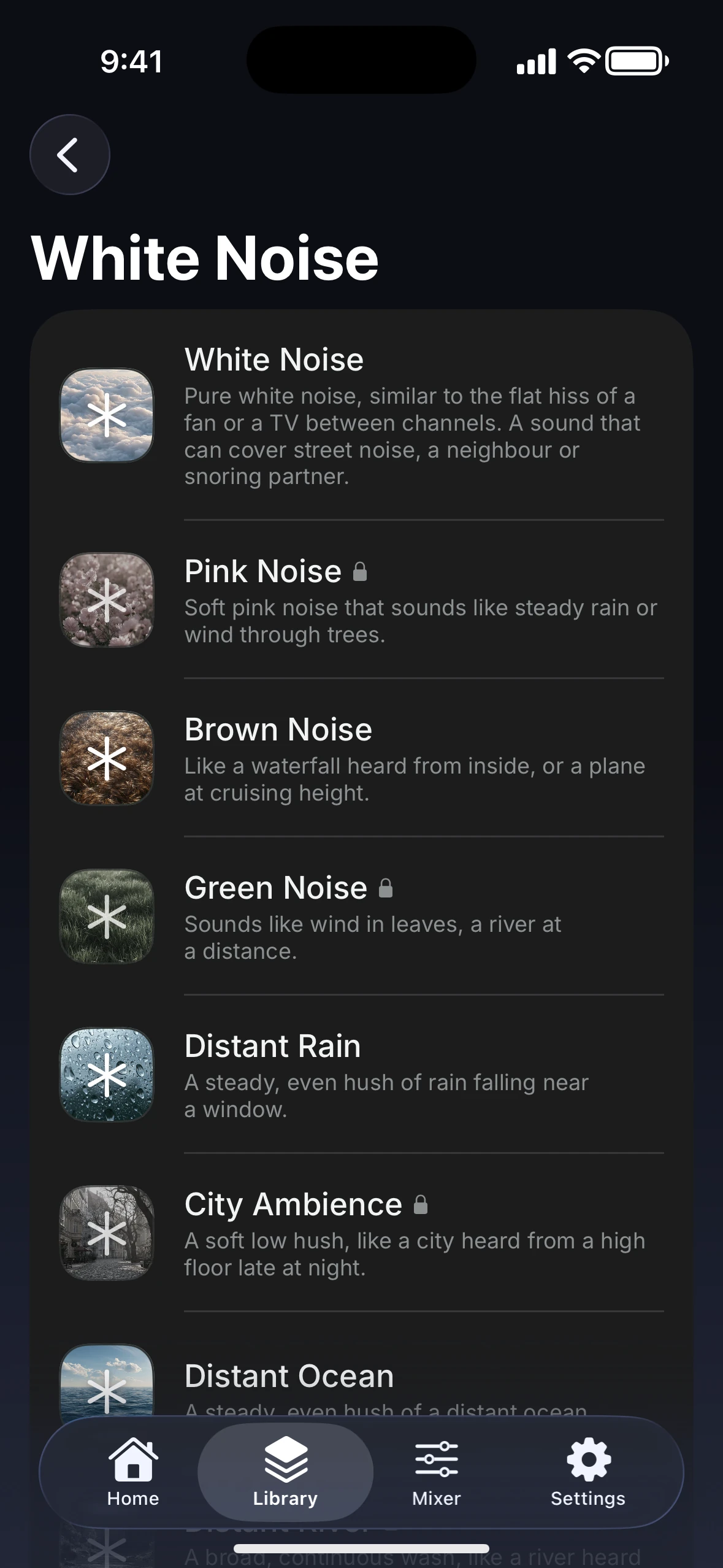
White noise is free in the PureSound app for iPhone and iPad. The app adds a timer, sessions at any length up to 12 hours with play and pause on the lock screen, and a Mixer that layers up to 3 sounds at once.
Free to start. No account needed.